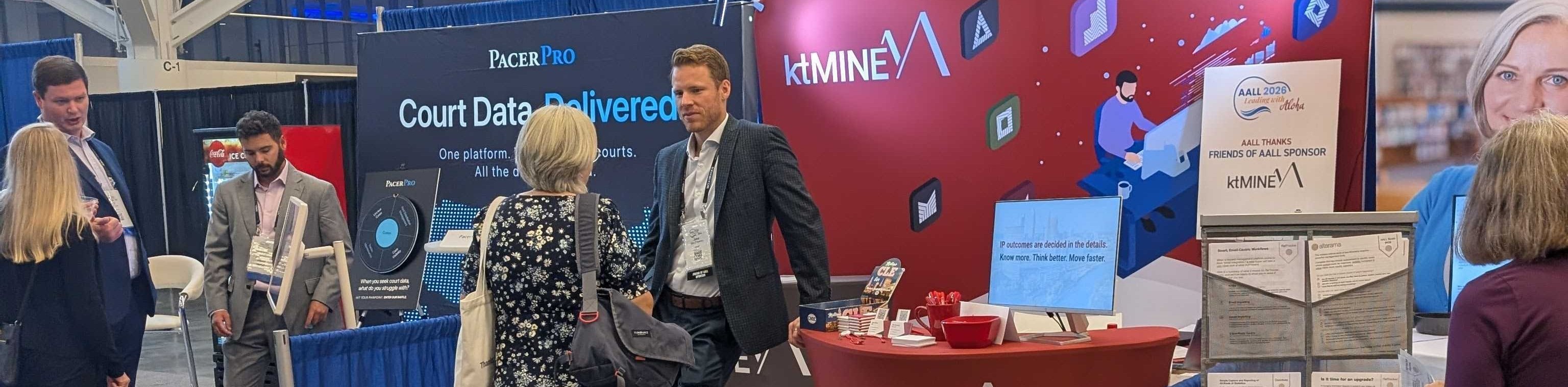
While it was no surprise that AI dominated tech conversations at the American Association of Law Libraries (AALL) 2026 Annual Meeting in Cleveland, skepticism undercut the curiosity, especially in regards to IP.
As we talked with attendees, we noticed a disconnect between what many vendors pitched versus what attendees sought, especially regarding transparency, operations, and budgets.
Operational Unity
While IP data and research dominated our conversations at AALL, we were surprised by how often we also fielded questions about operational concerns. These ranged anywhere from contract management to resource management to usage tracking.
Taking the AALL crowd as a whole, it seemed that research was not the end-all-be-all of law libraries’ desire for digital solutions. The AI-powered capabilities of ktMINE’s IP database search became an attractive proposition only after learning how its workflow improvement capabilities could slot into the firm’s overall functions.
This takes us to the most common gripe we encountered, regardless of the attendee’s function or interest: platform fatigue. While AI has a strong use case for law libraries, many of them found the prospect of having to adopt, onboard, and link several separate systems on top of having to conduct their usual work particularly daunting.
Law librarians and firm operations alike found one-stop hub solutions as the ideal approach, especially as they often felt out-of-depth trying to consider the technical complexities of several competing vendors at once.
The Black Box Problem
However, if a firm implements a centralized hub solution, it’s doubly crucial that any AI provides consistent functionality. After all, research must be defensible. Large Language Models (LLMs) solutions still struggle with consistency, accuracy, and reliability. Vendor marketing materials tend to sidestep the cost and reality of faulty outputs.
Some vendors leverage Model Context Protocols (MCPs) to impose repeatability and relevance. Law libraries find these especially attractive as they restrict the AI to just function off their already-existing databases. This way, librarians have a single, uniform way to ask for data and trigger actions.
Many vendors do not provide any way to check how their AI tools reach their conclusions. In these cases, IP researchers can use an MCP to consistently find and isolate pieces of obscure patent data; they have no clue if the system took a logical path to retrieve that data. Thus, the black box problem: when an AI tool, even a highly specialized one, spits out a legal conclusion, how did it get there?
Many attendees found ktMINE particularly attractive because we provide as much context to your prompt outputs as possible. For example, our transparent search builder walks the user through exactly how IP data is queried and how results are generated, giving the user full control over exactly how the search tool arrives at its conclusion.
Budgets and Tokens
Ultimately, many law firms approach AI-powered tools with caution because they are approaching the market at large with caution.
Law librarians harbor a distinct paranoia around the variability of AI token costs. Stories of unpredictable usage-based pricing models raise massive red flags for library operations. Some solution providers still lack clear answers as to how they measure and meter AI usage, making it difficult to forecast spend on vendors.
One reason why MCPs, including ktMINE’s, are still attractive in this environment are because they allow solution providers to build off of existing strengths.
We have an established track record providing accurate IP search and analysis. MCPs empower us to develop AI tools that use our reliable database as an anchor, rather than pulling and tacking on third-party feature sets.
Trust and Transparency
AALL 2026 proved that AI’s honeymoon phase is over. Law libraries need solutions that improve their operations in visible and reliable ways, with deciding factors being validity, predictability, transparency, and specificity.
Ready to see the difference? Learn how our IP data services demystify search building and provide true cost-certainty for your firm.[/vc_column_text][/vc_column][/vc_row]